/
/
AI in Wealth Management 2026: Solving the 5 Biggest Challenges Facing Advisors, Private Banks & Family Offices
AI in Wealth Management 2026: Solving the 5 Biggest Challenges Facing Advisors, Private Banks & Family Offices
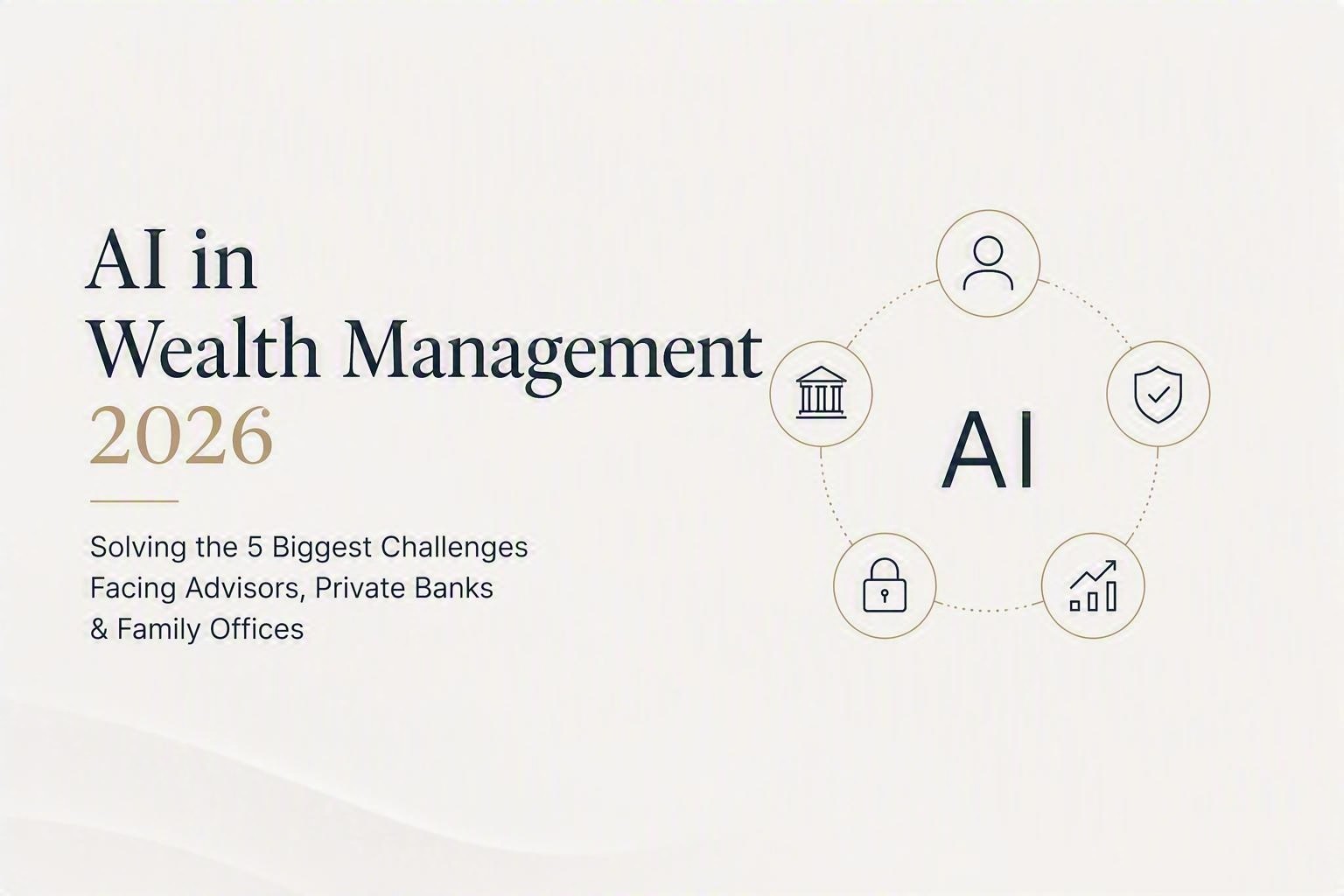
Artificial Intelligence is rapidly becoming a competitive advantage in wealth management. For advisors, private banks, and family offices, the opportunity is not simply about adopting new technology. It is about solving some of the industry's most persistent challenges.
From fragmented knowledge and increasing regulatory pressures to growing client expectations, firms are being asked to do more with less while maintaining the high-touch service clients expect.
The most successful firms in 2026 will be those that use AI to empower their teams, improve decision-making, and unlock the value of their institutional knowledge while maintaining control over their data.
Here are the five biggest challenges AI can help solve today.
1. Institutional Knowledge Is Trapped in Multiple Systems
Most wealth management organizations store information across multiple locations:
CRM systems
Shared drives
Emails
Research portals
Compliance repositories
Portfolio systems
Valuable knowledge often becomes difficult to find, resulting in wasted time and duplicated work.
Advisors regularly spend hours searching for information that should be available in seconds.
AI-powered knowledge management can transform the way teams access information by creating a single intelligence layer across the organization.
Rather than switching between multiple systems, employees can simply ask questions and receive instant answers based on approved internal content.
This allows wealth managers to spend less time searching and more time advising clients.
👉 Read more about DAFIN's approach to secure enterprise AI:
2. Advisors Spend Too Much Time Preparing for Meetings
Client meetings remain one of the most valuable activities for wealth managers.
However, preparing for those meetings often requires significant effort.
Teams typically need to review:
Portfolio performance
Previous meeting notes
Client objectives
Market developments
Internal research
AI can consolidate this information into intelligent briefing packs, helping relationship managers access relevant information instantly.
Instead of spending an hour preparing for each meeting, advisors can focus on delivering meaningful conversations and personalized guidance.
The result is better client engagement and improved advisor productivity.
3. Compliance Requirements Continue to Grow
Regulatory complexity remains one of the biggest challenges facing financial institutions.
Compliance teams are under constant pressure to ensure that employees have access to the latest policies, procedures, and regulatory guidance.
Unfortunately, critical information is often stored across multiple repositories.
AI can help compliance teams by:
Retrieving policy documents instantly
Supporting regulatory research
Improving document accessibility
Reducing administrative workloads
Strengthening governance processes
By improving access to knowledge, organizations can reduce risk while improving operational efficiency.
4. Client Expectations Are Higher Than Ever
Today's clients expect immediate answers, personalized insights, and proactive service.
Wealth managers are expected to understand complex client situations while staying informed about rapidly changing markets.
AI enables advisors to become more informed and responsive by providing:
Relevant research
Historical client context
Investment insights
Risk considerations
Internal knowledge retrieval
Rather than replacing advisors, AI enhances their ability to deliver exceptional service.
In an increasingly competitive market, this can become a significant differentiator.
5. Firms Need AI Without Losing Control of Their Data
Perhaps the biggest concern surrounding AI adoption is data control.
Financial institutions manage highly sensitive information, including:
Client records
Investment strategies
Family office structures
Internal research
Compliance documentation
As organizations adopt AI, maintaining ownership and control of information becomes critical.
The most successful firms will be those that embrace AI while keeping security, governance, and privacy at the center of their strategy.
This is where a security-first approach becomes essential.
At DAFIN, organizations can leverage AI across their internal knowledge while maintaining control of their data and respecting the requirements of regulated industries.
👉 Explore the DAFIN Platform
Why Data Control Will Define Successful AI Adoption
The future of AI in wealth management is not about replacing professionals.
It is about enabling them.
Organizations that successfully combine AI with:
Strong governance
Secure access controls
Data ownership
Human expertise
will be best positioned to thrive.
The firms that win in 2026 will not necessarily have the most AI.
They will have the most effective AI strategy.
One that empowers advisors, improves operational efficiency, strengthens compliance, and protects client trust.
Conclusion
For wealth managers, private banks, and family offices, AI is no longer a future consideration. It is becoming a strategic necessity.
The greatest opportunities lie in solving real business challenges:
Knowledge fragmentation
Advisor productivity
Compliance complexity
Rising client expectations
Data governance
Organizations that address these challenges today will be better prepared for tomorrow's competitive landscape.
By adopting secure, intelligent solutions such as DAFIN, firms can unlock the benefits of AI while maintaining control of the information that matters most.
👉 Learn More About DAFIN

Enterprise AI assistant for financial institutions. Secure, accurate, and transparent.
Solutions
© 2026 Dafin. All rights reserved.